


Some telephone systems come and go without making much of an impression. Others become so deeply embedded in the organisations that use them that they seem to go on forever. The Ericsson MD110 is most definitely one of the latter.
First introduced in 1983, the MD110 became one of the most successful business telephone systems ever developed. It found its way into hospitals, universities, government buildings, airports, hotels, industrial facilities and just about anywhere else that needed a serious telephone system. It also found a particularly comfortable home in the maritime industry, where its reliability, flexibility and rather clever architecture made it an excellent choice for ships of all shapes and sizes.
More than four decades after its introduction, there are still MD110 systems quietly going about their business on ships around the world. Some of them have been running for thirty years or more, and for the most part they just keep working. That’s quite an achievement for a piece of telecommunications equipment, especially when you consider the environments in which some of them have spent their lives.
I have a particular affection for the MD110. I started my telecommunications career as an Ericsson apprentice in 1995, when the system was already well established and widely regarded as one of the finest PBXs available. I’ve spent much of my working life with Ericsson, Aastra and Mitel telephone systems, and I’m still working with MD110 installations today. There aren’t many technologies from my apprenticeship days that I can say that about!
A little bit of history
Development of the MD110 began in the 1970s, when Ericsson and the Swedish telecommunications administration, Televerket, set about creating a new generation of digital telephone exchange.
The intention was to build a system that could accommodate the increasingly complicated communications requirements of large organisations, with the flexibility to expand and adapt as those requirements changed.
The result was something rather special. When the MD110 arrived in 1983, it introduced a highly modular, distributed architecture that was remarkably advanced for its time. It could be configured for a few hundred extensions, expanded into thousands, or distributed across multiple buildings and locations, all operating as a single telephone system.
Through the 1980s and 1990s the MD110 evolved continuously. New hardware, new software releases, additional features, digital trunking, ISDN, cordless telephony and eventually IP integration all became part of the system’s capabilities. Ericsson’s software releases, commonly referred to as BC versions, allowed the platform to develop over many years without requiring customers to replace everything whenever a new technology appeared.
The telecoms industry eventually moved towards IP telephony. Ericsson developed the MX-ONE platform as the successor to its traditional PBX technology, and the business subsequently passed to Aastra in 2008, then Mitel in 2014. The current Mitel MX-ONE still carries a great deal of the functionality and engineering heritage established by its predecessors.
The MD110 had a very long innings, and deservedly so.
What made the MD110 so good?
At the heart of the MD110 was its distributed architecture. Rather than having one enormous central processor responsible for every telephone and every call, the system was constructed from a series of Line Interface Modules, or LIMs.
Each LIM contained its own processing capabilities, switching hardware, software and interfaces for connecting telephones and external lines. Multiple LIMs could then be interconnected using a Group Switch, allowing them to work together as one large telephone system.
This was an exceptionally clever approach. Processing demands were distributed across the system, capacity could be increased by adding additional modules, and equipment could be positioned in different locations rather than everything having to reside in one enormous telephone exchange room.
It also offered some important resilience benefits. A fault affecting one LIM didn’t necessarily take down the entire telephone system, and properly designed installations could incorporate additional redundancy for critical components and interconnections. Local switching could continue under certain fault conditions, depending on the system configuration.
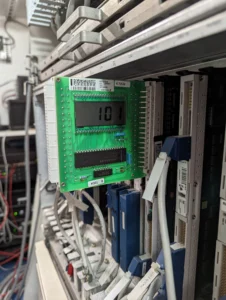
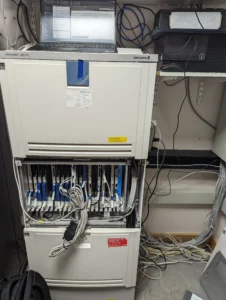
Then there was the hardware itself. Anyone who has worked on an MD110 will remember the familiar rows of cards and substantial equipment cabinets. They were beautifully engineered, and in my experience extremely reliable. Ericsson designed and manufactured equipment to standards that sometimes seem rather extravagant by today’s expectations.
The system was also tremendously flexible. Analogue telephones, digital system telephones, operator consoles, analogue trunks, digital trunks, tie lines and a huge selection of supplementary features could all be accommodated. It was possible to build some extremely sophisticated telephone networks using technology that, by modern standards, was relatively simple.
And perhaps most importantly, it was predictable. Once an MD110 had been correctly installed, configured and commissioned, it generally got on with the job. No endless software updates, no cloud service dependencies, no subscription server that needed to be contacted every few minutes. Just a telephone system doing what telephone systems are supposed to do.
Why was it so well suited to ships?
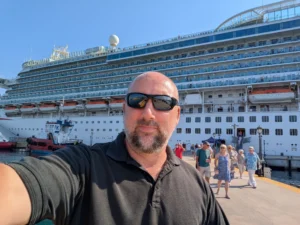
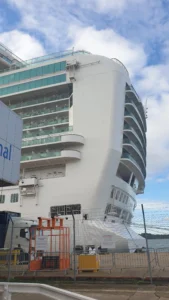
A ship presents some interesting challenges for a telephone system. Depending on the type of vessel, you might have anything from a few dozen extensions on a merchant ship to several thousand on a large cruise liner. Those extensions are distributed across multiple decks, accommodation areas, machinery spaces, operational departments and public areas.
You also have an unusual operating environment. Ships move around, electrical infrastructure can be complicated, access to specialist technical support is limited and, historically, connectivity to shore has been expensive, slow or completely unavailable for long periods.
If something breaks in an office building, you can usually arrange for an engineer to attend. If something breaks on a ship halfway across the Atlantic, things become rather more interesting. Particularly if the spare part you need is sitting in a warehouse in Sweden.
The MD110 was very well suited to this environment for several reasons.
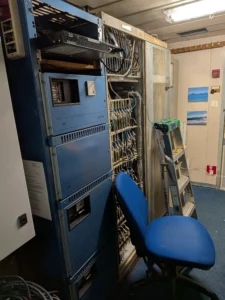
Firstly, its distributed architecture allowed equipment to be located around the vessel. A large cruise ship might have a main communications room containing the principal PBX equipment, with additional LIMs installed in other technical spaces. This could reduce the amount of extension cabling required and provide a more practical way of serving a very large, physically distributed installation.
Secondly, the MD110 was perfectly happy operating independently. Its basic telephone switching functions didn’t depend on an internet connection, a remote data centre or external authentication services. Provided the system had suitable power and the necessary local infrastructure, it could continue operating regardless of what was happening with the ship’s external communications.
Thirdly, the system’s resilience made it particularly attractive. With suitable configuration and redundancy, failures could be contained and the impact on other areas reduced. This was extremely useful on a vessel where reliable communications between departments are essential to daily operations.
Then there was its ability to accommodate virtually every type of telephone requirement you might find on board.
A cruise ship is effectively a floating town. It has hotel accommodation, restaurants, kitchens, entertainment venues, offices, engineering departments, workshops, medical facilities and operational control areas. Each has different requirements, and the MD110 could accommodate a tremendous variety of them within a common telephony platform.
A simple analogue telephone in a passenger cabin, a feature-rich digital handset in an office, an operator console at reception, a telephone in an engineering space or an analogue interface connected to a lift alarm dialler could all be supported. Appropriate interfaces and system configuration allowed the PBX to serve both the hotel operation and many of the vessel’s everyday operational communications requirements.
The MD110 wasn’t specifically a marine-hardened telephone exchange, and it still needed appropriate environmental conditions, power supplies and installation practices. Nevertheless, its fundamental architecture and considerable flexibility made it exceptionally well suited to the way ships were designed and operated.
I suspect its reliability was a major reason why so many shipowners and operators continued specifying it for years.
Forty years later, what’s the problem?
Unfortunately, even the finest engineering has its limits.
The MD110 is now a legacy platform, and the reality is that many of the installations still operating today are well beyond their intended service life. Some of the equipment is genuinely ancient by telecommunications standards, and although it may still be functioning perfectly well, maintaining it is becoming more difficult.
Spare parts are one of the biggest concerns. Cards can sometimes be obtained from specialist suppliers or recovered from decommissioned systems, but availability varies enormously depending on the hardware generation. Certain components, particularly some power supply and distribution units, are becoming increasingly difficult to source.
Then there is the software.
The MD110 went through numerous hardware and software generations. Access to original software, licences and specialist support tools is now extremely limited, and in some circumstances effectively impossible.
This creates a rather uncomfortable situation. A ship can have a telephone system that has worked faultlessly for thirty years, only to discover that a relatively minor hardware failure or a corrupted software installation leaves it with very few recovery options.
I’ve seen enough ageing telephone systems over the years to know that reliability can create a false sense of security. When something has been working continuously for decades, it is very easy to assume it will continue doing so indefinitely.
Where does the MD110 go from here?
For shipowners and operators still running an MD110, the sensible starting point is to understand exactly what is installed.
Which hardware generation is it? What software release is running? How many extensions are configured? Which analogue and digital interfaces are being used? Are there dependencies on other systems, such as lift alarms, voicemail, operator services or external communications equipment?
Just as importantly, what spare parts are held on board, and is there a viable recovery procedure if something significant fails?
Once that information is available, it becomes much easier to develop a sensible migration strategy.
At Litenet, we have a long history with Ericsson, Aastra and Mitel telephone systems, including supporting legacy MD110 installations and migrating shipboard systems to modern Mitel MX-ONE platforms. The advantage of this approach is that the modern system retains much of the functional heritage of the MD110, while offering contemporary IP telephony, SIP integration and support for legacy analogue equipment through suitable gateways.
There is no universal solution, of course. Every ship is different, and a successful modernisation project needs to account for existing cabling, telephones, interfaces, operational requirements and the practicalities of carrying out the work while a vessel remains in service.
What matters is planning the transition properly, ideally while the existing system is still functioning reliably.
Litenet are one of the last companies with in-house Ericsson Md110 experience. We work globally on dozens of vessels, supporting maritime customers directly and through third parties. We support a maritime Ericsson Md110 estate of well over 10,000 extensions around the world, and are actively migrating these to Mitel MX-One as.
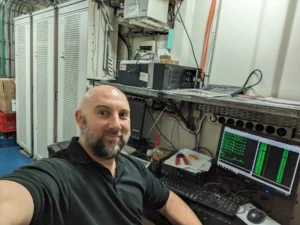
Written by Chris Thomas, Technical Director at Litenet. Chris began his telecommunications career as an Ericsson apprentice in 1995 and has spent more than thirty years working with business telephone systems, including the Ericsson MD110 and its successors. Today, Litenet specialises in supporting and modernising shipboard telephone systems around the world.